Like all head cabbages, the head-turning Kalibos belongs to the large and diverse Brassicae family, comprised of more than 3,700 species!
Brassicas are made into everything from salads to oil and animal forage to condiments.
Where Did Cabbage Come From?
Cabbages, or Brassica oleracea, descended from wild cabbage, which still grows on coastal limestone cliffs from Portugal to Denmark. Forage cabbage looks a lot like this wild ancestor, with its many branches and leaves.
It’s hard to know exactly how and where cole crops were first domesticated. One theory holds that the Celts domesticated head cabbage around 1000 BC in Atlantic coastal areas of what is now Spain and France. Others believe that cole crops were developed in the central and eastern Mediterranean. In any case, the fascinating story of cabbage’s travels can be told through etymology — and the ancient Celts are at the center of it.
How Did Cabbage Get Its Name?
First a little side note: Famed for their maritime skills — and more interested in trade than conquest — the Phoenicians began setting up ports and harbors around the Mediterranean Sea in the first millennium BC. They ranged far from their territory in what is now modern-day Lebanon, Syria and Israel. When they began trading with European Celts, they took cabbages back with them, calling them “burutzim,” after the Old Gaelic “braissech.” By early in the first century AD, when Romans dominated a large part of Europe, it became “brassica,” the word still used today as the genus name.
Most of the European and Asiatic names for cabbage can be traced to one of three Celtic or part-Celtic root words. Kopf Kohl (German), cabus and caboche (French), cabbage (English), kappes, kraut, kapost (Tartar), kopi (Hindu), and others, are all related to the Celto-Slavic cap or kap, meaning "head." Kaulion (Greek), caulis (Latin), kale (Scottish), kaal (Norwegian), kohl (Swedish), col (Spanish), are related to the Celto-Germanic-Greek caul, meaning "stem."
As it spread all over Europe, we saw the German word “kale” or “kohl” in German, both derived from the Greek “kaulos.” In Latin, the word “caulis” refers to the stem or stalk of a plant and cabbages meant for fresh eating. The English word “cabbage,” the German word “kumst,” and the Polish word “kapusta” likely derived from the medieval Roman word “compostus,” which referred to cabbages used for sauerkraut.
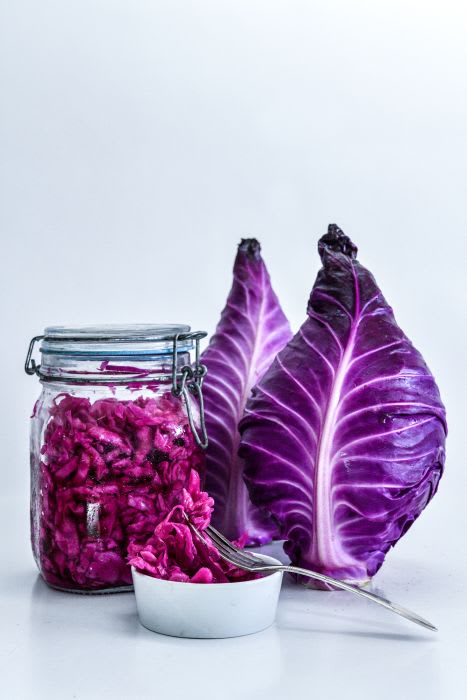
In colder regions of Europe, storing food for winter was a necessity, and by the 18th century, sauerkraut — fermented cabbage — had become a staple in central and eastern European diets. Root vegetables like beets and turnips were often added to the brine as well.
What Is the History of Kalibos Cabbage?
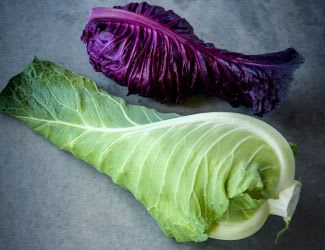
First known as the Vysoky cabbage (“Vysoky” is the Czech word for “high”) or the Vysocke cabbage in German-speaking areas, this beautiful, red-violet variety was mostly a curiosity. But it has become especially popular in community gardens in Czechia and Poland since breeders at the Institute of Experimental Botany, in today’s Czechia, improved it as a sauerkraut cabbage. The name Kalibos may just be a Czech variation of the German “kohl.” In any case, the stable and pure variety Kalibos was registered as an improvement of the Vysocke landrace in 1998.
Community gardens survived the communist era in Poland, and still thrive. On a visit to those beautiful gardens a few years ago the Kalibos cabbage caught our eye, and we decided to offer it at Baker Creek with seeds sourced directly from Poland.
What Is the Nutritional Profile of Kalibos Cabbage?
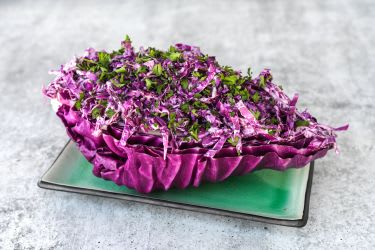
Cabbages, especially the red-colored ones, are packed with vitamins and contain unusually high levels of proteins for a vegetable — about 12 grams of protein in a 5-inch head. And Kalibos is higher in the nutritious anthocyanins that impart its reddish color.
Cabbage also contain glucosinolates, molecules that bind sulfur to carbohydrates. Those molecules are responsible for the pronounced typical odor of cabbage when cooking. For plants, they are a way to repulse insects. When consumed in excess, they can cause iodine deficiency; however, recent studies have demonstrated that they are helpful in preventing colon and liver cancer.
Cabbage is a nutritional superstar, and Kalibos is the most beautiful cabbage for sauerkraut!
Key Takeaways
- The precise story of how cabbage was domesticated remains in dispute; one theory holds that the ancient Celts developed head cabbage around 1000 BC in the region that is now parts of Spain and France; others hold that it was developed in the central and eastern Mediterranean.
- The distinctive red, pointy heads of Kalibos cabbage were developed from the Vysoky (or Vysocke) cabbage.
- Kalibos cabbage is nutritionally dense, with high levels of anthocyanins and even protein -- about 12 grams in a 5-inch head.
About the Author
Michelle Johnson is a nationally award-winning writer and editor with decades of experience in print, digital, and broadcast media.
She is also Baker Creek's resident 'seed historian,' digging into the back stories of celebrated and fascinating heirloom varieties from around the world.
Explore her Seed Stories video project on Baker Creek's YouTube channel.