


With their admirable adaptability, cheerful countenances, and vivid variety of colors, is it any wonder pansies are so beloved? They really are flowers for all seasons. You’ll find them blooming in winter gardens of the southern and southwestern U.S., in summer gardens of the north, and everywhere in between.
A Brief History of Pansies
Pansies, or Viola x Wittrockiana, are a 19th century English garden creation bred from Viola tricolor, a wild pansy commonly known as heartsease. Viola’s native range extends from much of Europe to western Siberia and northern Iran, and the petite, creeping wild flowers are a common sight of spring along riverbanks, in fields and meadows, and on rocky outcroppings. It has a long history of use in folk and herbal medicine as a tonic and treatment for epilepsy, skin diseases, and respiratory issues such as colds and asthma.
But its use wasn’t limited merely to physical ailments, apparently. According to Roman mythology, one of Cupid’s arrows struck a wild pansy, imbuing it with powers of affection and desire, and earning it one of its many names, ‘Love-in-Idleness.’
In A Midsummer Night’s Dream, William Shakespeare drew on the myth and the flower’s use in love potions when Oberon, the king of the fairies, dispatched his underling Puck to find wild pansies:
“Before milk-white, now purple with love’s wound,
And maidens call it love-in-idleness.
Fetch me that flower, the herb I showed thee once:
The juice of it on sleeping eyelids laid
Will make or man or woman madly dote
Upon the next live creature that it sees.” (Act II, Scene I)
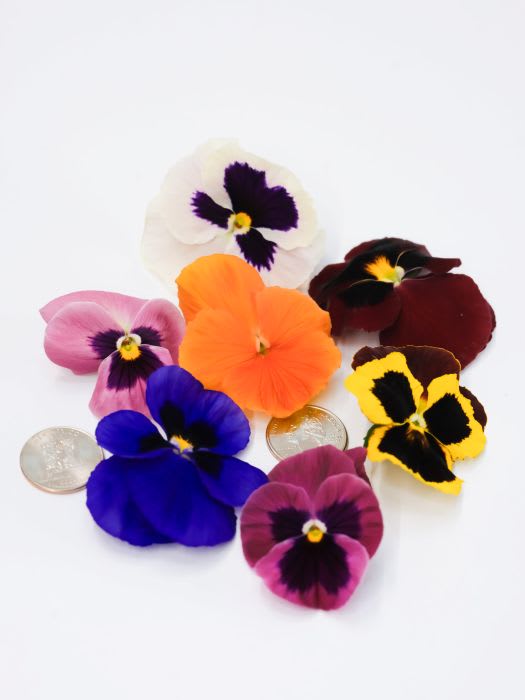
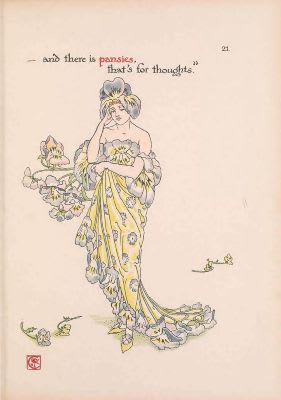
The name pansy is derived from the French word “pensée,” or “thought,” and came into use in the 15th century to refer to V. tricolor. In Act IV of Hamlet, Shakespeare also evokes the symbolism of pansies when, as Ophelia talks to her brother Laertes, she includes pansies in a list of plants that are believed to bring comfort.
“There’s rosemary, that’s for remembrance.
Pray you, love, remember. And there is pansies,
That’s for thoughts.”
Pansies became the darlings of European garden beds in the 19th century, after Admiral Lord Gambier, a retired sea captain, collected some wild violas on his estate in Iver, Buckinghamshire, England and gave them to his gardener, William Thompson, to improve. Thompson spent nearly 30 years working with the plants, selecting for unusual colors, color combinations and larger flower sizes. In the Flower Gardeners’ Library and Floricultural Cabinet for 1841, Thompson wrote that the plants Gambier gave him were “roots of the common yellow Heart’s Ease.” Heart’s-ease, or Heartsease, remained a popular name for pansies in seed catalogs of yesteryear.
Thompson wasn’t alone in his quest to improve the wild pansy of the time. Lady Mary Elizabeth Bennet, a daughter of the Earl of Tankerville, had also taken a shine to the flowers and, working with the gardener at their estate at Walton-on-Thames (which was not far from Iver), produced some very fine blooms.
In 1841, Thompson described a discovery that left him breathless: Two years earlier, as he was peering into a patch of flowers he had been neglecting, he saw “what appeared to me a miniature cat’s face steadfastly gazing at me. It was the flower of a Heart’s-ease … I immediately took it up and gave it a local habitation and a name.” Medora, as he called it, and its progeny, became the new species V. x Wittrockiana.
By 1850, gardeners had an abundance of varieties from which to choose. Breeding programs in Belgium and France, as well as in Switzerland, Scotland and England were producing many new strains. Pansies quickly made their way to American gardens, too, and by 1888, the H. H. Berger & Co. catalog exclaimed that “the pansy is one of the most popular of all the annuals, and justly held in the highest esteem.” That year, another U.S. company noted that it was selling more than 100,000 packets of pansy seed annually.
Pansy? Viola? What's the Difference?
Pansies’ enduring popularity is reflected in the development of innovative new varieties by breeders around the world, including in Japan, the U.S. and Germany.
Baker Creek offers a splendid selection of heirloom and open-pollinated varieties,including the Super Beaconsfield, a Giant Swiss type pansy with 3-inch wide, blue and white blooms.
Remember that all pansies are violas, but not all violas are pansies! Violas are smaller, with a different flower structure — two upward-pointing petals and three downward-pointing ones.
All pansies and violas are technically short-term perennials, but some cultivars/varieties have been selected for as annuals, and we recommend them as such. Others, such as Chicky Chicks viola, handle summer’s heat better and are listed as perennials. Climate and growing conditions also affect how these flowers will fare. In our Missouri gardens (USDA zone 7a), fall-planted pansies bloom prodigiously in spring.
Pansies love cool temperatures and full sun. The hotter the location, the more shade will be necessary. Pansies also love rich, moist and well-drained soils amended with compost. Deadheading the flowers will prolong blooming. While pansies and violas are generally pest and disease resistant, aphids, mealybugs, and spider mites can be a problem.
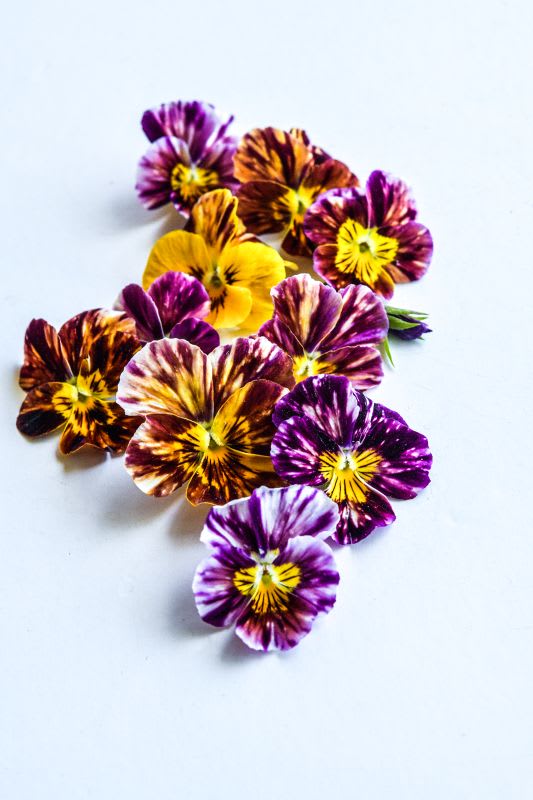
Pansies are champs in the garden, but more than that, they are brilliant bites of color in culinary creations. We love to toss them into salads, roll them in spring rolls, or use them as garnishes to create a memorable meal.
Key Takeaways
- Pansies were bred from a wild flower commonly known as heartsease.
- Wild pansy had many traditional medicinal uses.
- Breeders in 19th century England had a particular interest in developing varieties with different colors and petal sizes.
- While all pansies are violas, not all violas are pansies!
- Pansies love cool weather and full sun.


