Tomato Seeds,
Missouri Pink Love Apple

4.520 ReviewsSKU #TK128 · 25 seeds
Price
Regular price $4.00
Regular price $0.00 Sale price $4.00
Save $-4
/

FREE U.S. SHIPPING, 2-YEAR GUARANTEE


Description

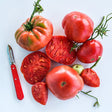
(Solanum lycopersicum). The big, pink fruit are very rich-tasting, certainly a favorite pink tomato. This potato-leaf variety has a long history in the “Show Me” state. It was grown since the Civil War by the Barnes family, who grew it as an ornamental, believing (as many people did at the time) that tomatoes, or “love apples,” were poisonous. We are grateful the Barnes family kept this variety going so we can enjoy the wonderful fruit today.

Plant Details

Botanical Name
Solanum lycopersicum
Growth Habit
Indeterminate
Sun Requirement
6–8 hr.
Days to Germinate
7–14
Days to Maturity
75–85
Planting Depth
⅛ in.
Plant Spacing
24 in.
Ideal Temperature
75–95°F
Frost Hardy
No

Growing Guide

When to Grow

Start seeds indoors 6-10 weeks before the last frost date in your region. Transplant outdoors only after the danger of frost has passed and the temperature doesn’t drop below 60 F. For shorter growing seasons, raised beds or black plastic mulch can help warm the soil and extend growing time.

How to Sow and Plant

  • As a tropical crop, tomatoes need plenty of warm weather and a long growing season. (Days-to-maturity figures count the time to first harvest from setting out transplants, which in turn take 6-8 weeks to grow before reaching transplant size.)
  • Avoid planting tomatoes too close to Brassica varieties such as cabbage, broccoli, and beets, as they may inhibit tomato growth.
  • In long-summer climates, they may be direct sown as soon as frost is past, but most gardeners start the tiny seeds indoors 6-8 weeks before the last spring frost date.
  • Either way, the seeds are just barely covered and germinate most rapidly in temperatures of 70 and above—80 degrees is best. (Use a heating mat indoors if necessary).
  • Seeds germinate in 7-14 days.
  • Once the sprouts appear, they require good light to grow well.
  • They may need to be fed once or twice to make good growth prior to transplanting outdoors, which happens after last frost.

How to Grow

  • Tomatoes tolerate a wide range of soil conditions but do best in deep, rich soil and in full sun.
  • Plants are usually staked but may be allowed to sprawl; spacing depends upon variety and which method is to be used.
  • Staked plants can be grown 18” apart in rows 3 or more feet apart; space 2-3 feet apart in rows 4 feet apart if the vines will be allowed to sprawl.
  • Determinate plants are usually smaller, requiring less space, and often need less support than indeterminate varieties. See above for a list of available determinate and semi-determinate varieties. Most varieties we sell are indeterminate.

PESTS/SPECIAL CONSIDERATIONS

  • Soil should be amended with plenty of compost; a little bone meal or other calcium source wards off blossom-end rot.
  • Hornworms can be controlled by daily hand picking; chickens love them. Hornworms are excellent camouflage artists, but their presence is marked by their excrement, which looks like small grenades.
  • It is also useful to keep tomato plants as far away from each other as practical in the garden.
  • If you find a hornworm that appears to have grains of white rice glued to its sides, it’s been parasitized, and that means the beneficial Braconid wasps have arrived to the rescue! Leave this hornworm in place as a nursery, and when the eggs hatch, the wasp larvae will eat the hornworm.
  • Pest control through “hiding” tomatoes in a polyculture planting can also be effective. Plant them with chili peppers, marigolds, borage, chives, nasturtiums, basil, calendula, sage, onions, and garlic.

How to Save Seeds

  • Most tomatoes are self-pollinating and don't frequently cross; in a garden setting, separating by 25 feet should prevent 99% of cross-pollination. Or you can bag and hand pollinate for 100% purity.
  • On a small scale, seeds may be scooped from the fruits and dried on a paper towel.
  • For larger quantities or cleaner seeds, fermentation for a few days is recommended.
  • Once dry, tomato seed can be stored in a cool, dry, dark place; good seed retains viability for 5 years or more.

FAQ

Why is it called a love apple?

This potato-leaf heirloom has been grown since the Civil War by the Barnes family of Missouri, who raised it as an ornamental because they believed, as many people did at the time, that tomatoes, or love apples, were poisonous. The big pink fruit are in fact very rich-tasting.

When should I start the seeds?

Most gardeners start the tiny seeds indoors 6 to 8 weeks before the last spring frost date and set the plants out after frost has passed; in long-summer climates they can be direct sown as soon as frost is past. Fruit follows in roughly 75 to 85 days from transplanting.

Can I save seed from this variety?

Yes, with a little care. Tomatoes are mostly self-pollinating, but potato-leaf beefsteak heirlooms like this one often carry exserted stigmas and cross more readily than ordinary tomatoes, so allow roughly 35 to 50 feet between varieties, or more where bumblebees are busy, or bag the blossoms and hand pollinate for complete purity. Scoop the seeds out and dry them on a paper towel, or ferment them for several days for larger or cleaner batches.
Customer reviews

4.5 / 5 20 Reviews

What gardeners are saying

  • Rich, low-acid flavor: Sweet and mild with little acid; a classic sandwich slicer.

  • Big meaty fruit: Big, meaty slicers, often over a pound, with solid flesh.

  • Heavy producer: Vigorous indeterminate vines keep setting fruit into late summer.

  • Seeds stay viable: Saved and older seed germinates nearly completely.

  • Heads up: Fruit runs more red than pink; expect a bit of cracking.

More to grow!

See all Tomato Seeds